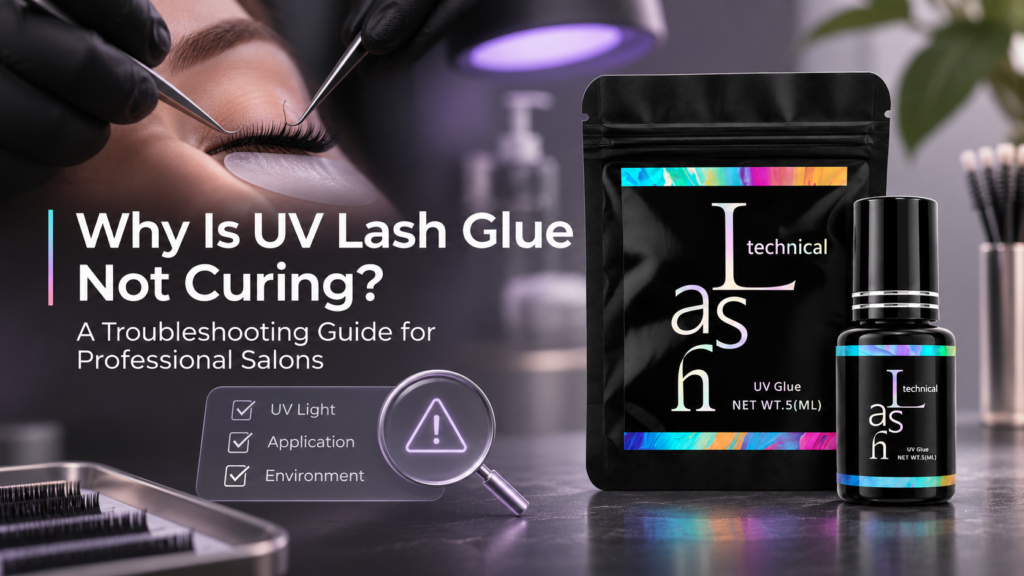
When UV lash glue stays tacky or extensions pop off sooner than expected, appointments become stressful and clients lose confidence. I often find that the issue isn’t simply “bad glue.” The lamp, adhesive, and curing technique must work together. Here’s how to troubleshoot them.
UV lash glue may not cure because the lamp’s wavelength is incompatible with the adhesive, too little light reaches the bond, or exposure time is insufficient. Poor lamp positioning, shadows, excess adhesive, and expired or improperly stored glue can also interfere with curing. To solve the problem, confirm that your adhesive and lamp are compatible, follow their manufacturers’ instructions, and check that the recommended light reaches the entire bond area.
I’ll walk through the likely causes, practical checks, and the equipment details that matter to lash professionals and wholesale buyers.
Why Is My UV Lash Glue Not Curing Properly?
When someone asks me why their UV lash glue is not curing, I start with the whole system rather than blaming one product. UV lash adhesive contains ingredients that react to particular light wavelengths. If the required light doesn’t reach the glue at the right intensity and for the required duration, the bond may remain incompletely cured.
Here are eight common causes and the first checks worth making:
| Possible cause | What to check |
|---|---|
| Wavelength mismatch | Does the adhesive supplier approve this lamp’s spectrum? |
| Insufficient light at the bond | Is the lamp positioned at the specified distance and angle? |
| Exposure too short | Are you following the adhesive’s validated curing procedure? |
| Shadows or blocked light | Can light reach the full adhesive joint? |
| Too much adhesive | Is the bond size within the supplier’s application guidance? |
| Old or poorly stored glue | Is the bottle in date and stored correctly? |
| Oil, moisture, or residue | Were lashes prepared according to the adhesive instructions? |
| Inconsistent lamp operation | Are the power supply, controls, and output working as specified? |
I would change one variable at a time, using the supplier’s approved test method. That makes UV lash glue troubleshooting far more useful than guessing or simply increasing exposure.
How Long Does UV Lash Glue Take to Cure?
There is no single curing time that works for every UV lash adhesive. Some systems are designed for very short, controlled exposures, but the correct duration depends on the formula, the compatible lamp, and the light actually reaching the bond.
Distance matters: moving a lamp farther away can reduce the light delivered to the adhesive. So can a poor angle or a shadow from surrounding lashes.
My advice is to follow the curing time specified for the exact adhesive-and-lamp combination. Don’t extend exposure on a client’s eyelid as an experiment. If curing remains inconsistent, stop and ask the supplier for a validated procedure.
What Wavelength Is Needed to Cure UV Lash Glue?
The correct UV lash light wavelength depends on the adhesive’s photoinitiator—the ingredient that responds to light and starts the curing reaction.
You may see lamps and adhesives advertised with different wavelengths, including ultraviolet and violet-light ranges. But a number on a product listing does not prove that two products are compatible. The lamp’s actual emission spectrum and the adhesive’s stated requirements both matter.
I recommend requesting the PLACEHOLDER: adhesive manufacturer’s technical data sheet and the lamp’s spectral specifications before combining products.
For distributors, this is particularly important. A UV eyelash extension lamp should be sold with clear compatibility guidance, not just a broad claim that it works with “all UV glues.”
How Do I Know If My UV Lash Glue Is Fully Cured?
A bond can look dry or feel firm without being completely cured. That is why I wouldn’t rely on appearance, a fingertip test, or a quick pull on a client’s extensions to prove success.
Instead, use the adhesive manufacturer’s validated curing process and any recommended quality checks on a separate test sample. If a supplier provides a defined testing method, follow it exactly and record the results.
Warning signs such as unexpected tackiness or repeated retention problems deserve investigation, but they do not identify the cause by themselves. When the result is uncertain, don’t assume the bond is safe or complete.
Can UV Lash Glue Cure Without a UV Light?
Usually, a light-curing lash adhesive requires light in a specified wavelength range to initiate its intended curing process. It should not be assumed to cure properly just because it has been left to sit.
That is different from conventional eyelash extension adhesives, which may cure primarily through reactions involving moisture. Some specialty products have different or combined curing mechanisms, so the label “UV glue” alone cannot tell us everything.
Before using any adhesive, I check the manufacturer’s instructions rather than treating UV and traditional lash glue as interchangeable. The PLACEHOLDER: adhesive instructions for use should explain the required curing conditions.
Does UV Lamp Power Affect Lash Glue Curing?
Yes, but lamp wattage and curing performance are not the same thing. Electrical wattage describes power consumption; it doesn’t tell you how much useful light reaches a tiny adhesive joint.
The more relevant measurement is irradiance at the working position, usually expressed as optical power per unit area. Spectrum, distance, beam shape, and stability also influence whether that light can cure the glue.
A lamp can appear bright while delivering the wrong wavelength or inadequate light at the bond. That’s why I would ask for output data at the recommended working distance—not just a high wattage figure.
When comparing a professional UV lash lamp, consistent, documented performance matters more than an impressive marketing number.
Can Expired UV Lash Glue Still Cure?
It might react to light, but that doesn’t mean it will cure or perform as intended. Adhesives can change during storage, especially when exposed to heat, unwanted light, or conditions outside the manufacturer’s recommendations.
I check the expiry date, opening or use-by period, packaging integrity, and storage instructions first. An unusual texture or inconsistent application is another reason to stop using a bottle.
For salon managers and distributors, tracking adhesive batches and storage conditions helps identify recurring complaints. Never rely on longer exposure to rescue expired glue; replace questionable stock and consult the manufacturer.
Why Are My UV Lash Extensions Falling Off?
Poor UV lash extension retention does not always mean the adhesive failed to cure. Retention also depends on lash preparation, proper bonding, product compatibility, and the client’s aftercare.
For example, an adhesive bond might be cured but weak because the natural lash wasn’t prepared correctly, or because the extension made inadequate contact. Alternatively, a lamp shadow may have left part of the bond undercured.
I would compare the failure pattern with application records, adhesive batch details, and lamp settings. If several technicians see the same problem with the same equipment, that’s useful evidence for supplier troubleshooting.
Use the PLACEHOLDER: adhesive manufacturer’s retention and application guide rather than guessing at a fix.
Is UV Lash Glue Safe for the Eyes?
UV lash extension safety deserves serious attention. Light exposure near the eyes can present risks, and adhesives themselves may cause irritation or allergic reactions. The specific risks depend on the lamp’s spectrum and output, exposure conditions, adhesive chemistry, and protection used.
I would never recommend shining a curing lamp into an open eye, improvising eye shields, or increasing exposure beyond the approved procedure. Follow the device and adhesive manufacturers’ instructions, use the protection they specify, and ensure technicians receive appropriate training.
Ask suppliers for relevant safety documentation, exposure information, and instructions for use. A certification or quality-management claim is not proof that a particular lamp-and-glue combination is safe.
For authoritative background, add a verified PLACEHOLDER: optical radiation safety reference before publishing. If a client experiences eye pain, vision changes, or significant irritation, stop the service and seek appropriate medical care.
How Do I Choose the Right UV Lash Curing Lamp?
When buying a UV lash curing lamp, I would prioritize compatibility and documented performance over appearance. A practical lamp should let the technician position the light precisely without compromising the supplier’s safety procedures.
Look for the correct emission spectrum, verified irradiance at the working distance, stable controls, clear operating instructions, and dependable construction. Adjustable positioning can help reduce shadows, but the final setup must still match the adhesive manufacturer’s requirements.
For salon owners, easy cleaning and repeatable operation are also important. For buyers purchasing multiple units, I would ask about production consistency, inspection procedures, spare parts, packaging, and support.
Censreal manufactures professional beauty lighting and offers OEM/ODM services. Buyers can contact the company to discuss UV lash lamp options and request model-specific specifications rather than assuming that every lamp suits every adhesive.
Can an Ordinary LED Eyelash Extension Lamp Cure UV Lash Glue?
Not necessarily. An ordinary LED eyelash extension lamp is designed to illuminate a technician’s workspace. That is different from delivering the specific light needed to cure a photoreactive adhesive.
Even a very bright salon lamp may have the wrong spectrum, beam pattern, or intensity at the bond. And the term “LED” tells you how light is produced, not whether the light will cure your glue.
I would keep general task lighting and curing equipment separate in purchasing specifications. If a product claims both functions, ask for test documentation covering each one.
This distinction is useful for wholesalers selling lash lights, half moon salon lamps, and dedicated UV curing systems.
How Can Professionals Improve UV Lash Extension Retention?
In my view, consistent UV lash extension retention starts with a repeatable process. Technicians need fresh, correctly stored adhesive, properly prepared lashes, a suitable bond size, and a lamp setup that matches the adhesive’s instructions.
Small changes in positioning can affect how much light reaches the joint. That’s why training and documented procedures are more dependable than relying on memory alone.
If a salon has recurring issues, I suggest logging the adhesive batch, lamp model, approved settings, and observed problem. This makes it easier to distinguish a handling issue from an equipment issue.
Good results come from the entire system, not a curing lamp alone.
What Should Wholesalers Look for in Wholesale UV Lash Lamps?
For importers and distributors, selecting wholesale UV lash lamps involves more than choosing a competitive unit price. Product consistency, technical documentation, quality control, and after-sales support can all affect customer satisfaction.
I recommend asking potential suppliers how they inspect finished units, manage production batches, handle defects, and provide replacement parts. Request applicable certification documents and confirm which exact products and markets they cover. Shipping arrangements, packaging, lead times, and payment terms should also be clear before placing an order.
Censreal is a China-based B2B beauty-lighting manufacturer with five production lines, ISO 9001 certification, and R&D, OEM, and ODM capabilities. Its product range includes LED salon lamps, half moon lash and nail table lights, and UV lash lighting.
An ISO 9001 quality-management certification is valuable supplier information, but it does not by itself verify UV output, adhesive compatibility, or optical safety. I would still request model-specific test reports before buying.
Explore Censreal’s beauty lighting range or contact the team to discuss wholesale requirements.
Final Thoughts
If your UV lash glue is not curing, check adhesive compatibility, the light reaching the bond, exposure instructions, storage, and application technique. Don’t guess with eye-area exposure. For dependable salon equipment sourcing, ask Censreal about UV lash lamp specifications, quality checks, and OEM/ODM options.
